Sock manufacturing MOQ means the minimum order quantity a supplier accepts for a defined production brief. It is one of the first numbers buyers ask about, but the headline figure does not explain how an order can be divided between designs, colours and sizes. This guide shows how to turn a starting quantity into a practical first collection, using ELBASOCKS’s 500-pair inquiry threshold as an example.
In this guide
1. Understand what sock manufacturing MOQ actually covers
A minimum may apply to the whole order, an individual design, a colour or a particular yarn programme. Those are different constraints. Ask the supplier to identify the level at which each minimum applies. Do not assume that a 500-pair starting order permits any number of small variants within that total. Confirm what sock manufacturing MOQ covers.
At ELBASOCKS, inquiries start at 500 pairs. The proposed design, colour and size allocation is reviewed during quotation. That makes the quantity a starting point for a discussion, not automatic approval of every possible combination. Include your preferred breakdown when asking for a quote so the response addresses the collection you actually intend to launch. Discuss complexity alongside sock manufacturing MOQ.
Ask what would change the accepted minimum. Special yarn sourcing, a new construction, complicated patterning or packaging requirements can affect feasibility. A useful explanation connects the quantity to production preparation and the proposed product. Keep the final accepted allocation in writing alongside the quotation. Share the matrix when reviewing sock manufacturing MOQ.
2. Reduce unnecessary complexity before increasing quantity
Each additional variant creates another decision about materials, artwork, sizing and stock. For a first collection, define a clear role for every proposed product. An everyday crew in a core colour may serve a different purpose from a seasonal fashion design. Remove variants that do not have a clear customer or sales channel. Size allocation belongs in sock manufacturing MOQ planning.
Complexity is not simply the number of colours. A shared construction with coordinated colours may be different from several unrelated constructions using different yarns. Discuss which elements can be shared without compromising the design. Let the technical review determine what is possible rather than assuming that visually similar products run identically. Check packaging alongside sock manufacturing MOQ.
Use your brand plan to prioritise. If the main proposition is a soft everyday sock, concentrate development effort there before adding specialist styles. Explore our everyday sock manufacturing and private label production pages to frame the options. A focused range can be easier to explain, approve and replenish. Keep sock manufacturing MOQ comparisons consistent.
3. Build a transparent 500-pair allocation
Consider an illustrative plan with two proposed styles at 500 pairs each. If each style has two colours, that becomes four style-colour combinations at 250 pairs each before sizes are allocated. If each combination then covers two sizes, the plan could contain eight stock-keeping units at 125 pairs each. These are planning calculations, not confirmed ELBASOCKS subminimums. Confirm sock manufacturing MOQ again for replenishment.
The calculation shows why an attractive total can conceal a fragmented order. Send the proposed matrix to the manufacturer and ask which combinations can be accepted. If the answer differs from your plan, revise the range, allocation or total rather than assuming that the original headline minimum overrides production constraints.
Use a spreadsheet with style code, colour reference, size, quantity and packaging variant. Add totals by style and overall order. Check that the units are pairs throughout; confusing individual socks with pairs can double or halve the intended quantity. Label the sheet as a proposal until the supplier has approved it.
4. Connect size quantities to your actual customer
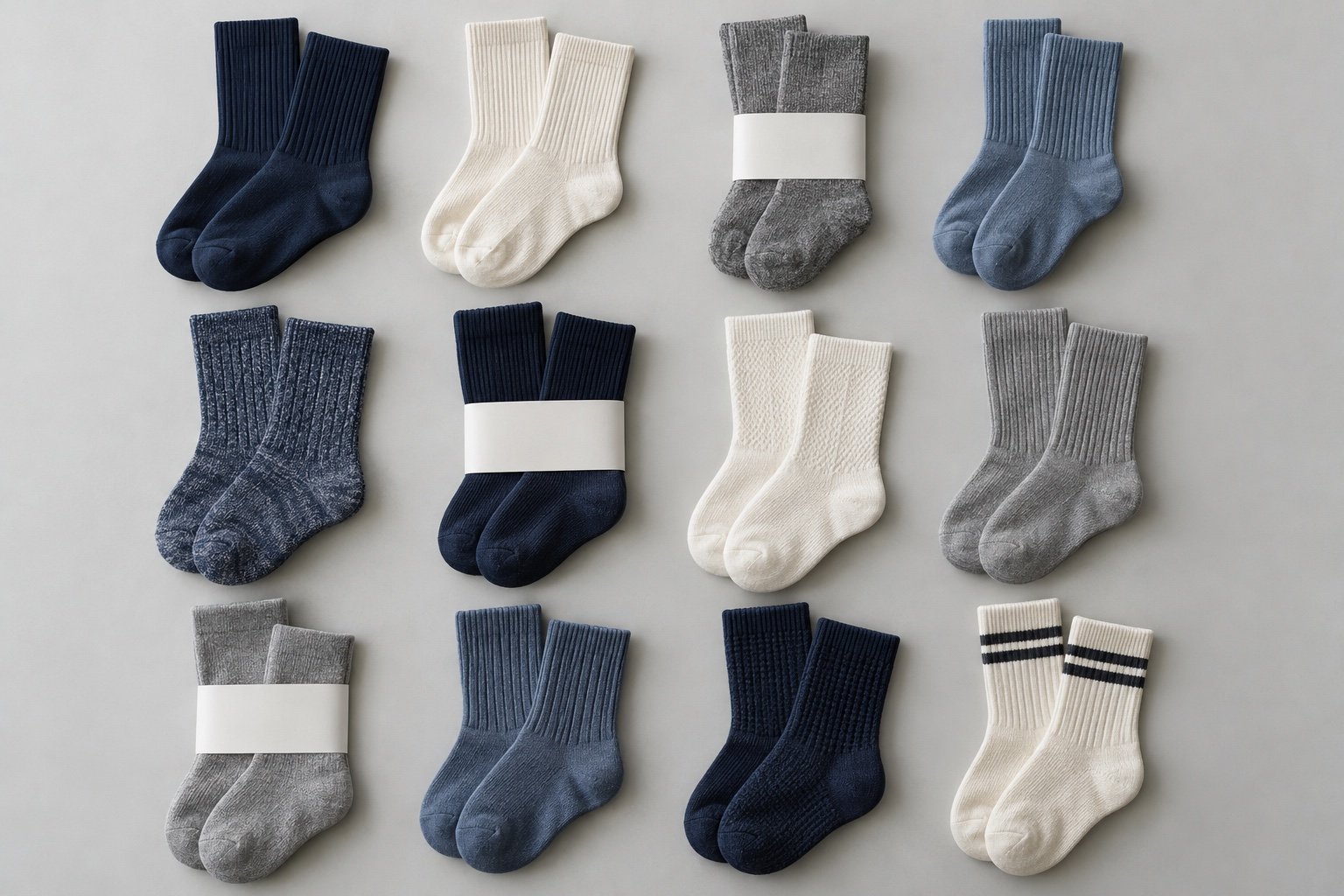
Size allocation should reflect the intended buyer rather than an automatic equal split. Consider the customer group, product fit and existing sales evidence if you have it. When launching a new brand, record the assumptions behind the allocation and keep the first range manageable enough to learn from.
Ask how the intended sizes relate to the proposed dimensions and construction. A label size is not a complete fit specification. Agree which physical samples or measurements are needed to review the size range. If a product targets children, specialist activities or a particular fit preference, make that clear before approving the plan.
Keep the product matrix connected to packaging. A size sticker, printed band or barcode may differ for every size even when the sock design is shared. Confirm how the manufacturer will identify each unit and carton. This helps the warehouse receive the order correctly and reduces avoidable sorting after delivery.
5. Include yarns, branding and packaging in MOQ discussions
Sock manufacturing MOQ can be affected by requirements outside the main knitted design. Ask whether a particular yarn colour, unusual fibre programme or packaging component introduces another minimum. Request alternatives if your preferred option creates disproportionate complexity for the first order.
Branding also needs a technical review. A knitted logo must work at the chosen scale and position. Packaging artwork must match the approved product and composition. Do not print final labels while key product decisions remain open. Read our sock packaging guide before finalising presentation requirements.
If you plan to make certification-related claims, include the documentation and artwork review in the brief. The official OEKO-TEX STANDARD 100 guidance explains the meaning of that label and how it can be checked. Confirm eligibility for the specific product; a certification requirement is not resolved by adding a logo to a band.
6. Compare the total order scope, not just the unit price
An increase in quantity may change the quotation, but there is no universal discount formula. Ask for comparable options using the same specification and state the proposed allocation for each. Distinguish a price change caused by volume from one caused by different yarns, construction or services.
Include development, packaging, testing and shipment preparation in the comparison. Clarify what is included, what is separately charged and what remains to be confirmed. Agree the quotation currency and validity period. Do not treat the cheapest displayed price as the cost of a fully specified order.
A larger purchase also means more stock to manage. Compare the potential unit saving with your ability to sell, store and replenish the range. A first order should provide useful commercial learning as well as inventory. Avoid increasing the quantity only to reach an attractive unit price if the additional stock has no clear purpose.
7. Plan replenishment before the first collection ships
Ask how an approved style is identified for a repeat order. Retain the product code, final specification, sample version, colour references and packaging files. Explain whether replenishment would repeat the full range or focus on the best-selling variants. The accepted minimum for a repeat programme should be confirmed rather than inferred.
Record the points that can affect reorder timing: material availability, any requested changes, approval requirements and the production schedule. If you need a target delivery window, raise it early and ask when it can be confirmed. Monthly production capacity is useful context but does not reserve your future order slot.
ELBASOCKS states a monthly capacity of one million pairs. Discuss your likely production programme through the manufacturing inquiry form. Provide a realistic first-order quantity and describe future demand as an estimate unless it is a confirmed commitment. This gives the team a practical basis for reviewing scale and timing.
Common sock manufacturing MOQ mistakes to avoid
Treating the total as a per-variant promise. Always confirm subminimums and allocation. An order can meet the overall threshold and still contain combinations that need adjustment. Share the matrix rather than only the grand total.
Using an incomplete brief to compare prices. Two offers are not equivalent if the yarn, construction, packaging or testing differ. Keep the product specification constant and ask suppliers to identify substitutions clearly.
Approving too many variants at once. Every variant should have a commercial purpose and a review plan. Remove duplication before adding volume. A smaller, coherent range can create a clearer product story and a more useful first-order evaluation.
Forgetting sample approval. Quantity planning does not replace product development. Agree the sample version and final specification before bulk production. Use the sock sample approval guide to organise that decision.
Leaving labels until the last moment. Composition wording, size information, branding and packaging quantities need to match the final product matrix. Confirm responsibility for artwork and review before printing or packing begins.
A practical inquiry template for your first order
Use the following structure: brand and destination; intended customer and use; proposed sock category; preferred composition; reference images or artwork; sizes; total quantity; style-colour-size matrix; packaging; testing or documentation needs; target timing. Mark any unknown items so the manufacturer can advise rather than guess.
For example: “We are developing an everyday crew collection for adult customers. Our proposed total is 500 pairs across two styles, with the attached colour and size allocation. Please confirm feasibility, the accepted minimum per combination, proposed materials, sampling steps and quotation scope.” This wording requests a review without claiming the allocation has already been accepted.
If the supplier proposes a simpler matrix, ask what the change resolves. It may reduce a material constraint, make sampling clearer or improve packing consistency. Record the accepted version and ensure the commercial offer uses it. A precise inquiry turns sock manufacturing MOQ from a vague barrier into a concrete planning decision.
Frequently asked questions
Can I mix colours within 500 pairs? Propose your preferred mix and ask ELBASOCKS to review it. The starting quantity does not guarantee unrestricted splitting between colours, sizes and designs.
Is the minimum the same for every sock category? Do not assume so. The construction, yarn programme and packaging can affect the accepted allocation. Confirm the requirements for the particular product during quotation.
Should a new brand order more to reduce unit cost? Compare like-for-like quotations and consider your stock plan. A lower unit price is only useful if the larger quantity supports a realistic sales and replenishment strategy.
What is the next step? Prepare the product brief and proposed matrix, then request an order-specific review. The accepted allocation, specification and terms should be clear before you approve bulk production.
Worked example: revise a fragmented launch plan
Imagine a brand proposing a 500-pair first collection with four styles, three colours per style and two sizes per colour. An equal split would create twenty-four stock-keeping units, with a little over forty pairs per unit on average. That calculation does not establish whether the plan is manufacturable. It reveals a question for the supplier: can those combinations be accepted under the intended yarn and construction programme?
The brand then reviews its commercial priorities. Two styles serve almost the same customer, so it removes one. A seasonal colour has no launch campaign, so it postpones that option. The resulting range is simpler without changing the core proposition. The buyer sends a revised matrix and asks the supplier to identify any remaining constraints. This is an illustrative planning exercise, not an approved ELBASOCKS allocation.
The important step is the conversation between the matrix and the product brief. A smaller number of variants may reduce complexity, but a new technical construction may still need a different review. The manufacturer should confirm the accepted breakdown before the buyer approves the order. Sock manufacturing MOQ becomes much more useful when it is discussed with an actual range plan rather than as an isolated headline number.
Create a matrix that purchasing and receiving can share
Give every style a stable code and use the same code on artwork, sample feedback and the quotation. Add colour reference, size label, quantity in pairs and the intended packaging version. If you use barcodes, keep those identifiers in a separate controlled column and confirm who provides them. The purpose is to ensure that every person handling the order can identify the same product combination.
Add totals at several levels. The buyer should be able to see the overall number of pairs, the total per style and the total per style-colour combination. Check that all rows use the same unit and that the sum matches the quotation. If the supplier suggests a different allocation, create a revised version rather than editing an old email attachment without a new date.
Share the final accepted matrix with the team preparing packaging and the team receiving stock. A manufacturing order can be technically correct but difficult to receive if carton identification does not match the buyer’s product system. Agree the identification and packing information before dispatch. This operational detail belongs beside the sock manufacturing MOQ discussion because each extra variant adds another item to identify and reconcile.
Separate launch assumptions from confirmed requirements
A new brand may not have reliable sales history. That does not prevent planning, but it makes the assumptions important. Write down why you expect a certain size or colour to sell and how the first order will test that idea. Use the smallest coherent range that supports your launch story and the accepted manufacturing constraints. Avoid presenting an uncertain forecast as a guaranteed replenishment programme.
For an established brand, use its own product evidence where relevant. Existing sales may help prioritise sizes or colours, but consider whether the new construction targets the same customer. A dress sock range and a performance range may behave differently. The order plan should reflect the actual product and market rather than copying a previous allocation mechanically.
Keep a distinction between desired timing and confirmed timing. Tell the supplier about campaign dates and receiving needs, then ask which dependencies must be resolved before a commitment can be made. A large total quantity does not automatically create a faster schedule. Sock manufacturing MOQ, material availability, sample approval and production planning should be discussed together, with each confirmed decision recorded.
Review the first order before expanding the range
When stock arrives, check the quantities and identifiers against the accepted matrix. Record whether the packing structure makes receiving easy and whether any combinations need clarification. Use the actual product references in your records so a reorder can be linked to the original specification. If you want a change, describe it separately rather than requesting the same item while informally altering its yarn or dimensions.
As sales information develops, review the allocation by style, colour and size. Consider which variants earn a place in the next order and which create stock without serving a clear customer need. A successful first range may justify additional designs, but expansion should have a reason. Share the proposed programme with the manufacturer early enough to review feasibility and scheduling.
Reconfirm sock manufacturing MOQ for the next brief, especially when materials, constructions or presentation change. The first accepted allocation is useful evidence of what was agreed for that order; it is not a permanent promise covering every future product. Keep the commercial and technical review proportionate to the change so replenishment remains clear without assuming that important requirements can be carried over automatically.